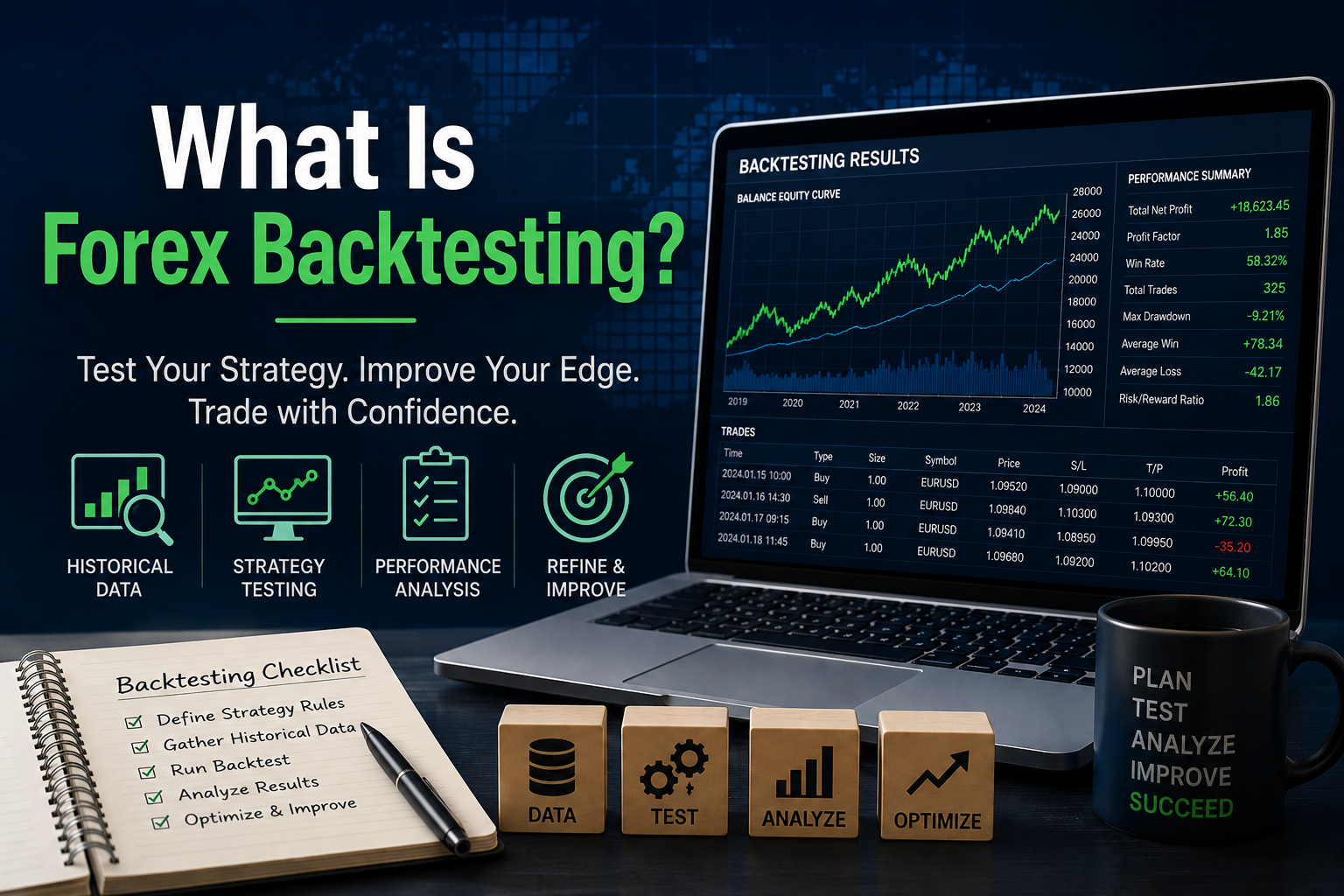
For anyone starting their journey in forex trading, learning how to evaluate a trading strategy before risking real money is essential. One of the most effective ways to do this is through forex backtesting.
Backtesting allows traders to see how a strategy would have performed using historical market data. While it cannot predict future results with certainty, it can provide valuable insights into a strategy’s strengths, weaknesses, and overall reliability.
In this guide, we’ll explain what forex backtesting is, why it matters, and how beginners can use it to improve their trading decisions.
What Is Forex Backtesting?
Forex backtesting is the process of applying a trading strategy to historical price data to determine how it would have performed in the past.
Rather than placing live trades, traders use historical market information to simulate buying and selling decisions based on predefined rules.
For example, if a strategy states that a trader should buy whenever a moving average crosses above another moving average, backtesting allows them to review previous market data and identify how many times this setup occurred and whether those trades would have been profitable.
Backtesting is a key part of forex testing and is widely used by both manual and automated traders.
Why Is Backtesting Important?
Many new traders are tempted to trade immediately after learning a strategy. However, using a strategy without testing it first can be risky.
Backtesting offers several important benefits:
- Helps determine whether a strategy has historically been profitable
- Builds confidence before trading with real money
- Identifies weaknesses in a trading system
- Allows traders to optimise entry and exit rules
- Improves overall risk management
Although past performance does not guarantee future results, understanding how a strategy behaved in previous market conditions can help traders make more informed decisions.
How Does Forex Backtesting Work?
The process of forex backtesting involves analysing historical data and recording the results of trades generated by a strategy.
Step 1: Define Your Trading Rules
Before starting, traders need a clear set of rules.
These might include:
- Entry conditions
- Exit conditions
- Stop-loss placement
- Take-profit targets
- Position sizing rules
The more precise the rules are, the more accurate the testing process will be.
Step 2: Gather Historical Data
The next step is obtaining historical price data for the currency pair you wish to trade.
Many trading platforms provide years of historical information, allowing traders to test strategies under different market conditions.
Step 3: Apply the Strategy
Once historical data is available, traders can begin applying their rules to previous market movements.
This can be done manually by reviewing charts or automatically using software tools.
Step 4: Record the Results
After testing is complete, traders should analyse key performance metrics such as:
- Total profit or loss
- Win rate
- Average winning trade
- Average losing trade
- Maximum drawdown
- Risk-to-reward ratio
These statistics provide a clearer picture of whether a strategy may be worth pursuing.
Manual vs Automated Backtesting
There are two main approaches to backtesting.
Manual Backtesting
Manual testing involves scrolling through historical charts and identifying trade opportunities one by one.
This method can be time-consuming, but it helps traders develop a better understanding of market behaviour.
Manual backtesting is often recommended for beginners because it encourages patience and improves chart-reading skills.
Automated Backtesting
Automated testing uses trading software to analyse thousands of historical trades within seconds.
Traders simply enter their strategy rules, and the software performs the calculations automatically.
Automated backtesting is particularly useful for complex strategies or algorithmic trading systems.
What Is Forex Testing?
While forex backtesting focuses specifically on analysing historical data, forex testing is a broader term that includes several methods of evaluating a trading strategy.
Forex testing may involve:
- Historical backtesting
- Forward testing on a demo account
- Paper trading
- Strategy optimisation
- Stress testing during volatile market conditions
Combining different forms of testing gives traders a more complete understanding of how their strategies might perform.
Common Mistakes to Avoid When Backtesting
Although forex backtesting is a powerful tool, it is important to avoid common mistakes.
Using Too Little Data
Testing a strategy over only a few weeks or months may not provide reliable results.
Ideally, traders should examine several years of historical data to account for different market environments.
Changing Rules Frequently
Altering strategy rules every time results are disappointing can lead to unrealistic expectations.
Consistency is important when evaluating a system.
Ignoring Trading Costs
Spread costs, commissions, and slippage can significantly impact profitability.
These expenses should always be included when conducting backtesting.
Over-Optimising a Strategy
Some traders modify their strategy repeatedly until it performs perfectly on historical data.
This process, known as curve fitting, often results in strategies that fail when applied to live markets.
Tools for Forex Backtesting
Several popular trading platforms provide built-in testing capabilities.
MetaTrader 4 (MT4)
MT4 includes a Strategy Tester that enables traders to analyse Expert Advisors using historical data.
It is widely used because of its simplicity and extensive community support.
MetaTrader 5 (MT5)
MT5 offers more advanced testing features, including:
- Faster processing speeds
- Multi-currency testing
- Additional reporting tools
- Improved optimisation functions
Both platforms are valuable resources for traders looking to conduct effective forex testing.
Final Thoughts
Forex backtesting is one of the most valuable skills a trader can learn. By testing strategies against historical data, traders can gain confidence, identify potential weaknesses, and improve their decision-making process.
While backtesting cannot guarantee future success, it provides a structured and objective way to evaluate trading ideas before risking real capital.
For beginners, combining forex backtesting with demo trading and ongoing forex testing can help create a more disciplined and informed approach to the markets. Taking the time to test and refine a strategy today could save significant time and money in the future.