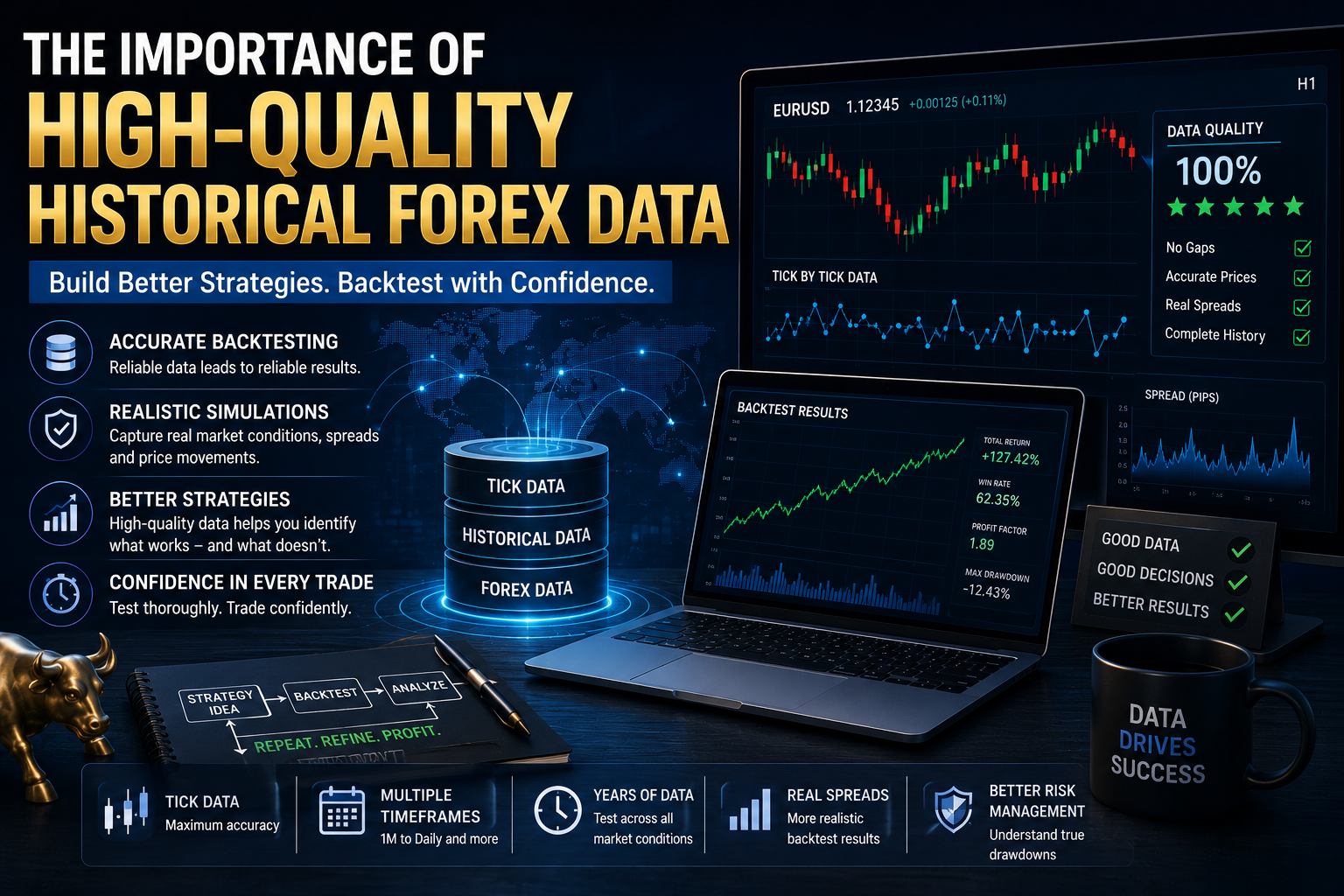
Developing a profitable trading strategy requires much more than finding a good entry signal. Before risking real money, traders need confidence that their ideas have performed well under different market conditions. This is where backtesting becomes an essential part of the strategy development process.
However, a backtest is only as reliable as the information used to create it. Poor quality historical data can produce misleading results, causing traders to overestimate a strategy’s potential profitability.
In this article, we’ll explore why high-quality backtest data is so important, the different types of forex data available, and how accurate tick data and appropriate timeframes can significantly improve the reliability of your trading results.
What Is Historical Forex Data?
Historical data refers to archived price information collected from financial markets over a period of time.
For forex traders, this information typically includes:
- Opening prices
- High prices
- Low prices
- Closing prices
- Trading volume
- Bid and ask prices
- Spread information
- Individual market ticks
Historical market information acts as the foundation for backtesting, allowing traders to evaluate how a strategy would have performed in previous market environments.
Without sufficient data, it becomes difficult to determine whether a trading system has a genuine statistical advantage.
Why Is Historical Data Important for Backtesting?
The purpose of backtesting is to simulate how a trading strategy would have behaved if it had been traded in the past.
If the underlying backtest data contains gaps, inaccurate pricing or unrealistic spreads, the results produced may be unreliable.
High-quality historical data helps traders to:
- Evaluate strategy performance objectively
- Measure potential drawdowns
- Calculate realistic profit expectations
- Understand how strategies perform during different market conditions
- Identify weaknesses before risking capital
Testing a strategy using poor data can sometimes create the illusion of profitability, only for the strategy to fail when traded live.
Understanding Different Types of Forex Data
Not all forex data is created equally.
The level of detail available can have a significant impact on testing accuracy.
OHLC Data
OHLC stands for:
- Open
- High
- Low
- Close
This is the most common form of historical pricing information.
Each candle contains only four price points for a particular period.
For example:
- One candle on a one-hour chart contains the opening price, highest price, lowest price and closing price for that hour.
OHLC data is often sufficient for longer-term trading systems, such as swing trading or position trading strategies.
Tick Data
For traders seeking the highest possible testing accuracy, tick data is generally considered the gold standard.
Tick data records every individual price change that occurs in the market.
Rather than simply storing four prices per candle, tick data captures thousands of market movements throughout a trading session.
This level of detail allows traders to simulate:
- Intrabar price fluctuations
- Variable spreads
- Precise order execution
- Slippage effects
- Stop-loss and take-profit behaviour
Strategies that rely on small price movements, such as scalping systems, can benefit significantly from using high-quality tick data.
The Importance of Accurate Backtest Data
Eliminating False Results
One of the biggest dangers of poor quality backtest data is generating unrealistic performance statistics.
For example, missing price ticks could cause a stop-loss order to be ignored during testing.
This may artificially increase profitability and reduce apparent drawdowns.
In live trading, those missing movements would have affected the outcome of the trade.
Realistic Spread Simulation
Spreads in the forex market constantly change depending on market conditions.
Economic announcements, low liquidity periods and broker pricing models can all cause spreads to widen.
High-quality historical datasets often include floating spread information.
This produces more realistic backtests and allows traders to better estimate future performance.
Accounting for Market Events
Historical datasets covering many years of price activity include major economic events such as:
- Interest rate decisions
- Financial crises
- Unexpected geopolitical events
- Periods of unusually high volatility
Testing strategies against these conditions helps traders understand how robust their systems truly are.
Why Timeframes Matter in Forex Testing
The timeframes selected during testing can significantly influence strategy performance.
A strategy designed for the five-minute chart may behave very differently when applied to the one-hour chart.
Common trading timeframes include:
| Timeframe | Typical Trading Style |
|---|---|
| 1 Minute | Scalping |
| 5 Minutes | Short-term Intraday Trading |
| 15 Minutes | Day Trading |
| 1 Hour | Swing Trading |
| 4 Hours | Medium-Term Trading |
| Daily | Position Trading |
Using data that matches the intended trading timeframe is essential for obtaining meaningful results.
Multi-Timeframe Strategies
Some traders analyse several charts simultaneously.
For example:
- Daily charts to identify trend direction
- Four-hour charts for setups
- One-hour charts for trade entries
Testing these approaches requires complete datasets across multiple timeframes to ensure all signals are generated correctly.
Historical Data as Training Data for Strategy Development
Although training data is commonly associated with artificial intelligence and machine learning, it also plays an important role in traditional strategy development.
Historical price information effectively acts as training data, helping traders refine and optimise their systems.
By analysing large quantities of market data, traders can:
- Adjust stop-loss distances
- Improve entry timing
- Compare different indicators
- Test alternative money management techniques
- Discover previously unnoticed weaknesses
However, traders should avoid excessive optimisation.
A strategy that is perfectly tuned to historical training data may struggle when exposed to future market conditions.
This phenomenon is often referred to as curve fitting.
Where Can Traders Obtain Quality Historical Forex Data?
Several platforms and providers offer high-quality historical market information.
Examples include:
- Forex Tester
- MetaTrader History Center
- Dukascopy
- TrueFX
- Tick Data Suite
- Broker-provided historical feeds
When selecting a data provider, traders should consider:
- Data accuracy
- Tick completeness
- Spread information
- Number of available instruments
- Frequency of updates
Premium datasets may involve additional costs, but many traders consider them a worthwhile investment when developing long-term trading systems.
Common Mistakes Traders Make When Using Historical Data
Testing with Too Little Data
A strategy tested over only a few weeks or months may not have experienced enough market conditions to provide reliable results.
Ideally, traders should analyse several years of data whenever possible.
Ignoring Tick Accuracy
Strategies using tight stop-losses can become highly sensitive to minor price movements.
Testing these systems using candle-based data alone may produce misleading outcomes.
Assuming Past Performance Guarantees Future Results
Even perfect historical data cannot predict future market behaviour.
Backtesting should be viewed as a probability exercise rather than a guarantee of success.
Final Thoughts
High-quality historical data is one of the most important components of effective backtesting.
Whether traders are evaluating simple moving average systems or sophisticated algorithmic models, the reliability of their results depends heavily on the quality of the underlying forex data.
Using detailed tick data, realistic spreads and sufficient backtest data across multiple timeframes can help traders make better decisions and develop strategies with greater confidence.
For anyone serious about forex strategy testing, investing time in sourcing accurate market information may ultimately prove just as important as the strategy itself.